


No products in the cart.
You Don’t Have a Marketing Problem. You Have a Brand Problem.

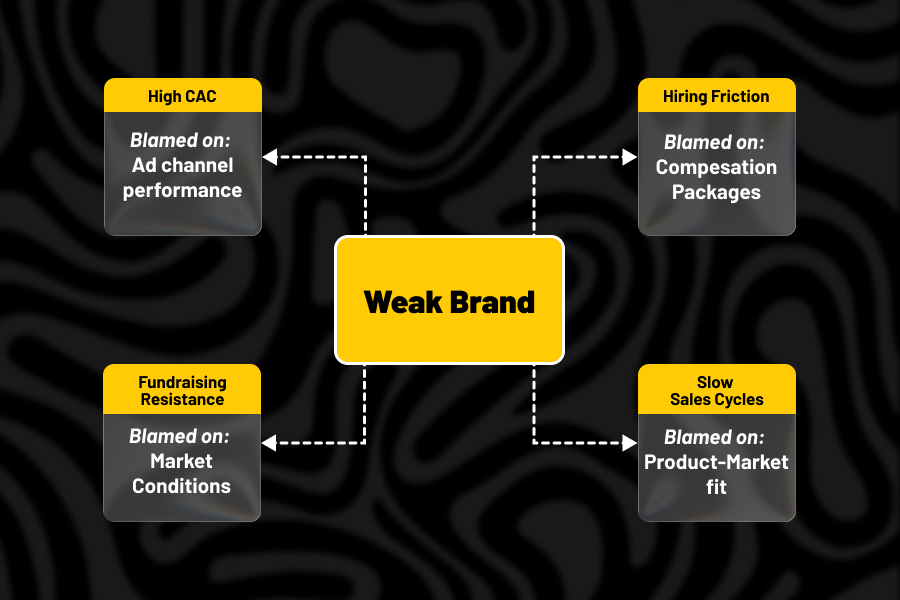
Your customer acquisition cost is not a marketing problem. Your closing rate is not a sales problem. Your hiring friction is not an HR problem. They are all the same problem, wearing different masks and the founders who keep solving them separately keep paying for the same problem three times over. The problem is the brand.
Not the logo. Not the colour palette. The brand, the full impression your business makes before a single conversation happens, and the credibility it either carries or fails to carry once that conversation begins.
Across the African startup ecosystem, there is a pattern that repeats with uncomfortable regularity. Across the African startup ecosystem, there is a pattern that repeats with uncomfortable regularity. A founder identifies sluggish growth and immediately reaches for a marketing solution. They put ₦500,000 into a Google Ads campaign, hire a social media manager, brief an agency on a content push and for a while, the activity feels like progress. The dashboard fills with impressions. But the numbers that actually matter don’t move the way they should. Leads come in and stall. Conversion costs climb. The team keeps spending, and the results keep disappointing.The activity feels like progress. But the numbers don’t move the way they should. Leads come in and stall. Conversion costs climb. The team keeps spending, and the results keep disappointing.
The diagnosis was wrong from the start.
Brand weakness hides in plain sight
Brand failure doesn’t announce itself. It doesn’t show up as a line item on a balance sheet. There is no invoice labelled ‘cost of weak brand identity.’ Instead, the damage spreads quietly across other metrics, metrics that look like separate problems but are actually connected. Here is how the pattern typically runs: The research is unambiguous about what connects all four of those outcomes. McKinsey’s analysis of B2B companies published in ‘B2B Business Branding’ found that companies with strong brands outperform weak-branded competitors by 20 percent. Not because their product is better, but because brand recognition reduces friction at every stage of the funnel. Prospects who already trust the brand convert faster. Sales cycles shorten. Each marketing channel performs better when it is reinforcing something the market already believes. Weak brands have to brute-force every conversion. They pay a premium in time, spend, and effort for trust they haven’t built. That is what the elevated Customer Acquisition Cost (CAC) is actually measuring. Arounda Agency’s 2026 branding research adds the revenue dimension: brands with consistent presentation across channels generate up to 23 percent more revenue, with inconsistency directly influencing decisions at the comparison and pricing stages. That gap isn’t theoretical. It is the difference between a brand that closes and one that keeps almost closing.
Most African founders who believe they have a marketing problem actually have a brand problem, and solving the former without the latter is expensive waste..
Why founders reach for marketing first
Marketing is visible. You can point to a campaign. You can track impressions. You can show a board that something is happening. Brand work is slower, more abstract, and harder to defend in a monthly review.
There is also a timing problem. By the time the brand issue becomes undeniable by the time a founder can no longer explain away the friction as market conditions or product gaps — the damage has usually been compounding for over a year. Atla Design’s 2026 analysis found that by the time a rebrand feels necessary, the brand has typically already been costing the business in sales cycles, hiring, and fundraising for 12 to 18 months prior.
That is 12 to 18 months of elevated costs, missed deals, and lost candidates that never appear on any report as brand-related losses. They get logged as market headwinds. As product-market fit questions. As team performance issues. The real cause stays invisible.
The trust gap that marketing cannot close
There is a specific dynamic in African markets that makes this problem more acute. Across Nigeria, Ghana, Kenya, and beyond, trust is a fundamental prerequisite for commercial relationships and trust is built differently here than in markets where institutional credibility does most of the heavy lifting.
In these contexts, brand is not cosmetic. It is infrastructure. It is the visible evidence that a business is serious, stable, and worth the risk of engagement. When that infrastructure is weak or inconsistent, no volume of marketing spend can substitute for it.
MarTech Africa’s 2025 research on startup marketing mistakes in Africa found that startups which skip local brand validation and rely on assumptions frequently misallocate marketing spend into channels that cannot close the trust gap the brand has already created. The channels are reaching people. The brand is failing to convert them.
What it looks like when brand is ignored
TeamApt is the most instructive local example of this. For years, TeamApt operated as a backend infrastructure provider to Nigerian banks. The technology was strong and genuinely impressive, quietly powering significant portions of Nigeria’s payment rails. But the brand was invisible to the businesses it was increasingly trying to serve. When TeamApt moved to capture the SME banking market directly, it hit a wall. Despite processing the majority of POS transactions in Nigeria and disbursing over $1.4 billion in working capital loans, the parent brand registered as little more than industry jargon outside fintech circles. It did not resonate with the 600,000+ businesses using its products. The product had outgrown the brand entirely.
The cost of that gap showed up in ways that are now familiar: lower brand recognition than competitors with inferior products, partnership conversations that required extensive re-explanation of who TeamApt actually was, and a hiring profile that struggled to attract talent who couldn’t find the brand in their frame of reference. The technology was not the problem. The brand was doing none of the sales work.
What it looks like when brand is built deliberately
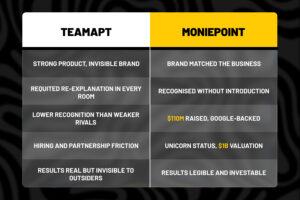
In January 2023, TeamApt made a decision most Nigerian fintechs don’t have the discipline to make: it retired a name that had served its B2B origins and replaced it with the brand its customers had already built their trust around. The company became Moniepoint Inc. — the name of the product that had become synonymous with reliable POS transactions for hundreds of thousands of Nigerian businesses — and in doing so, removed the single biggest barrier between what the company was and what the outside world could see.
The brand gap was real and documented. TechCabal reported at the time that despite processing the majority of POS transactions in Nigeria and disbursing over $1.4 billion in working capital loans, TeamApt did not enjoy the same level of brand recognition as competitors like OPay and Paystack. A marketing expert quoted in the same report described the rebrand as motivated by the parent company’s “lukewarm reception with the general public” — the product was trusted; the company was invisible.
What happened after the rebrand is instructive. In October 2024, Moniepoint closed a $110 million Series C backed by Google’s Africa Investment Fund and Development Partners International, achieving unicorn status at a $1 billion valuation. The Financial Times named it one of Africa’s fastest-growing companies for two consecutive years. Investors cited the company’s profitability, its 150% revenue CAGR, and its market position as their rationale — the financial fundamentals were always there. What the rebrand did was make those fundamentals legible. It gave investors, partners, and talent a brand name that matched the scale of what the business was actually doing, and removed the friction of having to explain why a company called TeamApt was one of Nigeria’s most consequential fintechs.
The lesson is precise: branding does not create results. It makes the results you have already built impossible to overlook. Without it, the quality of your work is real, but only to the people already close enough to see it. More spend into a broken funnel does not fix the funnel. It makes the waste more expensive.
What a weak brand actually costs and where to look
Founders tend to feel brand problems before they can name them. Here are the most common places the cost shows up, and the honest questions to ask about each:
On Customer Acquisition Cost (CAC)
If your CAC has been trending upward without a clear external explanation no market shift, no channel saturation, ask whether the brand is doing enough of the sales work before the first conversation happens. A prospect who has already formed a credible impression of your business arrives warmer. One who hasn’t needs to be convinced from zero, and that convincing costs money on every channel you run.
On deal values and sales cycle length
If your deals are closing slower or at lower values than comparable businesses in your space, ask whether the brand is holding a credible position or conceding it under pressure. When a brand can’t justify its pricing through the impression it makes, the conversation defaults to discount. The product doesn’t change. The brand’s inability to command the room does the damage.
On hiring
If strong candidates are accepting offers elsewhere, look at what your business communicates to someone who has never spoken to you. Check your LinkedIn presence, your website, any press coverage or absence of it. Candidates research before they decide. What they find — or don’t find — shapes their confidence in the role before a single interview happens.
On fundraising and partnerships
Investors and partners conduct diligence independently. What your brand communicates before that first pitch meeting is already shaping their frame. A brand that reads as unsophisticated, inconsistent, or undefined creates a credibility gap that the founder then has to spend the meeting closing — instead of making the case for why the business is worth backing.
These are not rhetorical questions. They are diagnostic ones. And they matter because the answer shapes where the fix actually needs to happen.
Marketing budgets optimise distribution. Brand investment builds the asset that makes distribution worthwhile. Without the latter, you are filling a leaking bucket and calling it a growth strategy.
Where to start
The goal of this piece is not to suggest that marketing doesn’t matter. It does. But marketing works best when it is amplifying something that already holds weight — a clear identity, a credible positioning, a brand that people form a view on before the first conversation.
For most African founders, the most commercially valuable thing they can do right now is not launch a new campaign. It is to run an honest audit of what their brand is currently communicating unprompted, to someone who has never met them.
That audit doesn’t require an agency. It requires three honest questions:
- What does a cold prospect find when they search your company name for the first time and does what they find match the quality of what you actually deliver?
- When you enter a pricing conversation, does your brand give you the room to hold your number, or does the prospect arrive already expecting a discount?
- When a strong candidate or investor looks you up independently, do they find evidence of seriousness or gaps that create doubt before you’ve had a chance to speak?
Moniepoint answered all three of those questions honestly in 2022 and built the brand to match the answer. By 2024, investors were writing nine-figure cheques not because the product had changed — but because the brand had finally closed the gap between what the business was and what the world could see.
If any of those answers are uncomfortable for your business, that discomfort is data. It is telling you that the brand is already costing you — in CAC, in deal value, in hiring, in rooms you haven’t been invited into. It is just doing so quietly, across metrics you’ve been attributing to something else.
The costs of a weak brand are real, recurring, and compound. They just don’t come labelled. That is precisely what makes them dangerous.


Leave a Reply